Over the past twenty years, the way people live, communicate and take in information has changed beyond recognition. Today’s learners, particularly Generation Z and Generation Alpha, grew up with smartphones in hand, surrounded by short-form content and used to instant interaction. Yet many education systems still run on teaching models built for a different world: one that suited Generations X and Y, who grew up at a slower pace and learned largely through traditional rote instruction.
That widening gap between the culture of today’s learners and the tools of traditional education has become one of the biggest challenges facing educational institutions around the world.
How digital natives engage with learning
Recent research suggests that digital-native learners don’t engage with content the way earlier generations did. They respond to material that is fast, visual, direct, interactive and personalized. One scientific review of Gen Z’s characteristics found that this generation tends toward short, well-structured learning and interactive multimedia content, with a strong need for immediate feedback and personalized learning.
Perhaps the most important question today is no longer “How do we bring technology into the classroom?” It is “How do we redesign learning itself around the way this generation learns?”
Rethinking the 50-minute lesson
The 50-minute class period made sense when knowledge was hard to come by and the school’s main job was to pass information on directly. Today’s learners live in an open, always-on information environment, and staying focused through a one-way lesson has become much harder.
Several studies indicate that younger generations respond better to microlearning. Instead of long lectures, microlearning delivers skills and concepts in short, focused units. Recent research shows that this model strengthens engagement among Gen Z learners, because they are used to absorbing information quickly and in small doses.
That raises a reasonable question:
Does a lesson really need to last 50 minutes, or does it matter more that the target skill is clearly defined and well taught?
Many modern education models are already moving from time-based learning to skills-based learning, where the goal is a clear learning outcome reached in less time, with more focus and more impact. This doesn’t mean eliminating the role of schools or teachers. It means redefining both to suit the nature of today’s learner.
Why self-directed learning is becoming essential
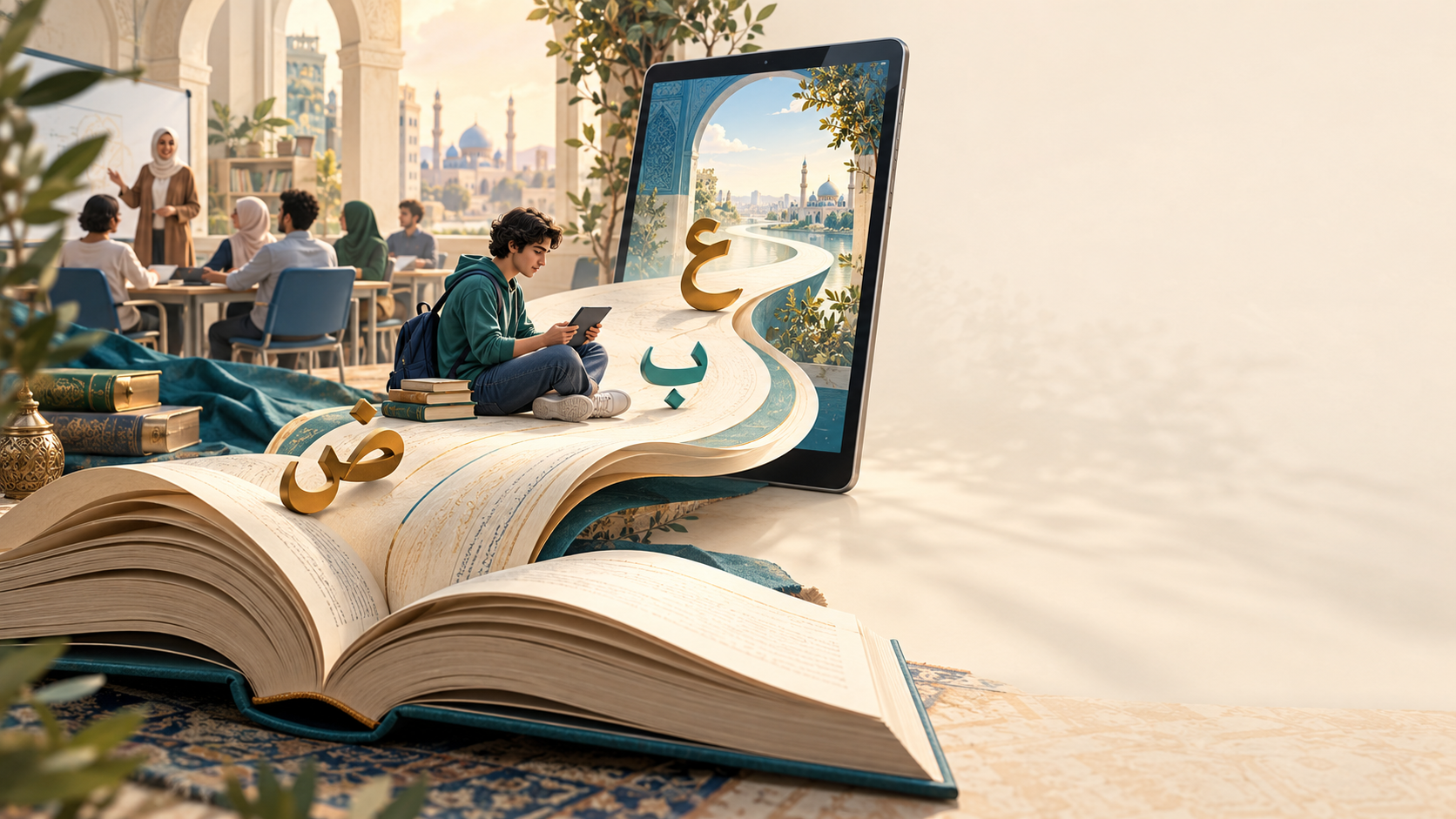
Against this backdrop, self-directed learning stands out as one of the models best suited to the digital age. Today’s learners want to study at their own pace, on their own schedule, and in a way that brings quick wins and a steady sense of progress.
Recent scientific reviews show that self-directed learning supported by technology and educational apps contributes effectively to language learning, increases motivation and supports sustainable, long-term learning. Studies also confirm that learning through smartphones and interactive apps increases learner autonomy, giving learners a greater ability to keep going, practice through repetition and learn flexibly.
In language learning specifically, online platforms have proven they can deliver tangible results when they are built on:
- Continuous interaction
- Clear progression
- Short, direct learning
- Immediate feedback
Arabyati: an Arab model for self-directed learning
Within this context, Arabyati can be seen as an Arab model that seeks to respond to this global shift in how people learn, particularly in teaching Arabic to non-native speakers and heritage learners.
The platform is built around self-directed learning of the most commonly used skills in Arabic. Its content is concise, direct and practical, designed for the way digital generations learn, and it brings together:
- Short educational drama
- Continuous interaction
- Smart repetition
- Fast-paced visual content
The result feels less like a rigid classroom routine and more like a flexible part of everyday life.
The aim isn’t simply to digitize education. It is to rebuild the learning experience itself so that it becomes faster, clearer, more interactive and better suited to the way digital-native minds work.
A balanced future for education
Even so, the future of education does not necessarily mean abandoning traditional teaching entirely. The goal is a balanced approach that brings together:
- the human connection a teacher provides,
- the flexibility of self-directed learning, and
- the effectiveness of online learning and microlearning.
The real challenge isn’t resisting change. It is accepting that learners have already changed, and that the tools of education need to change with them.
Today’s learners look for knowledge the way they live their lives: quickly, clearly, flexibly and on their own terms. The institutions that thrive in the years ahead won’t necessarily be the most traditional or the strictest. They will be the ones that best understand how the new learner learns.
References
- “A Systematic Review of Gen Z’s Learning Characteristics and Preferences.” ResearchGate.
- “Generation Z: Learners’ Profiles and Teaching Challenges.” PMC, 2025.
- “The Role of Microlearning in Enhancing Learning Engagement Among Gen Z Students.” 2026.
- “Self-directed Learning for Optimizing Sustainable Language Learning via Mobile-Assisted Language Learning.” Frontiers in Education, 2025.
- “Evaluating the Effectiveness of Online Language Learning Platforms for Non-native Learners.” 2025.
- “Supporting Learners’ Self-management for Self-directed Online Language Learning.” Emerald Insight, 2023.
- “The Application of Digital Technology and the Learning Characteristics of Generation Z in Higher Education.” arXiv, 2021.
- “Microlearning Turns Your Tiny Attention Span Into a Powerful Force.” Investors Business Daily, 2025.